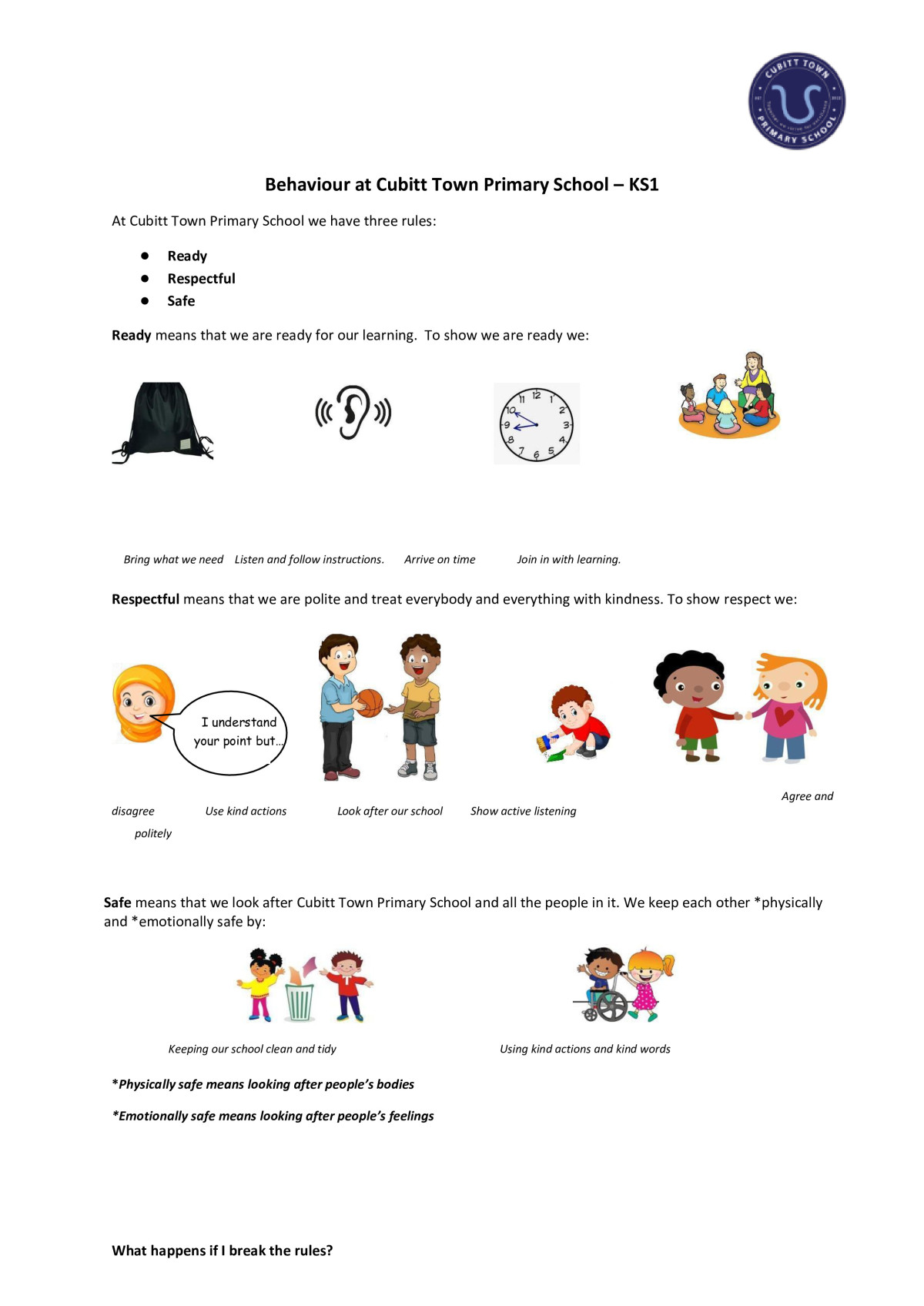
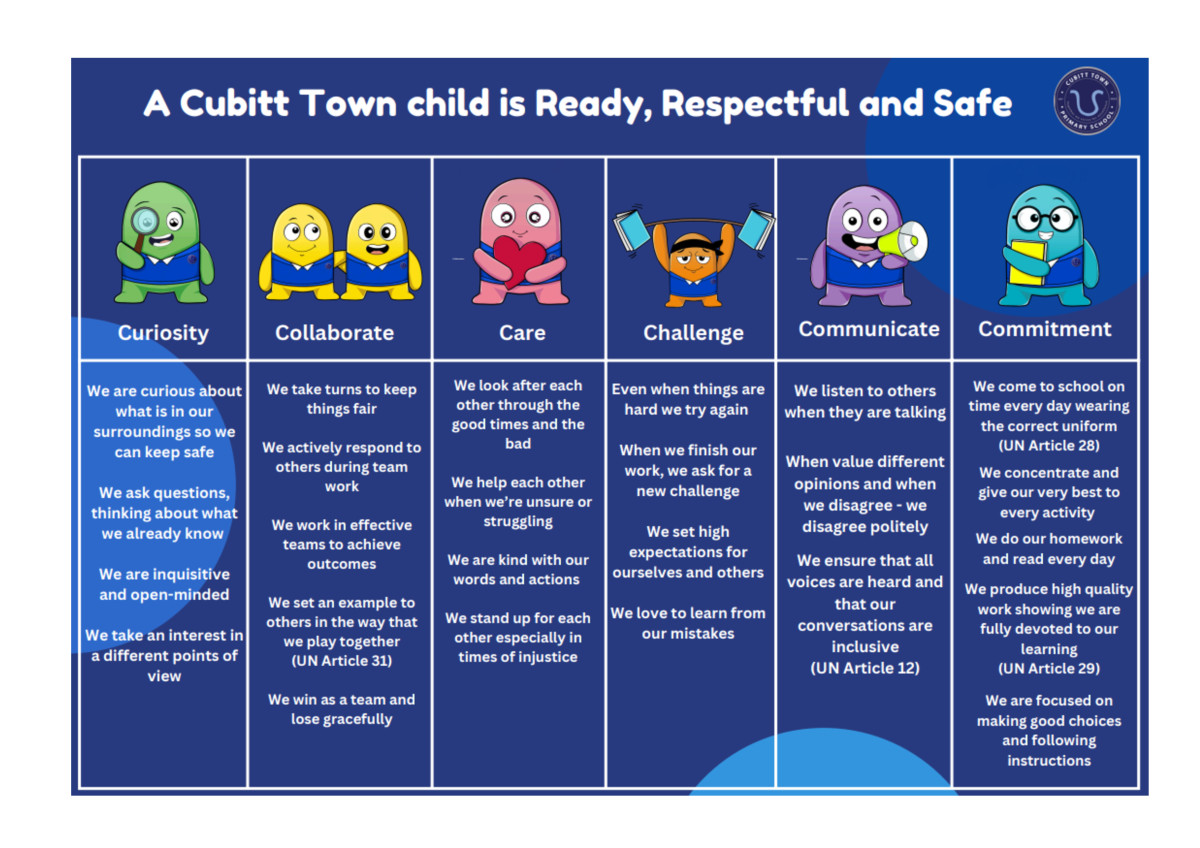
Ready to learn, respectful to all, keep yourself and others safe
At Cubitt Town Primary School, we believe that good behaviour occurs when children feel they are in a stable and secure environment and when their learning is engaging and pitched at the correct level. We take a preventative approach to behaviour management. Every adult in our school understands that behaviour is a form of communication and it is therefore encouraged to look beyond behaviour and to be curious about children’s needs. All children will be treated with kindness and compassion no matter how challenging their behaviour is. We actively teach children how to make the right choices and how to build relationships with others - we refer to these as positive 'Green Behaviours'. We have a positive and inclusive approach to managing emotions and well-being, which is built on recognising that behaviours are driven by emotions and that children need help in learning how to identify and manage their emotions.
The relational (relationship building) approach is based on the belief that children need consequences that teach, rather than punish. Logical consequences, rather than arbitrary ones, are fairer and help children to understand the effect their behaviour has on others. The way we behave at Cubitt Town Primary School is underpinned by the principles of:
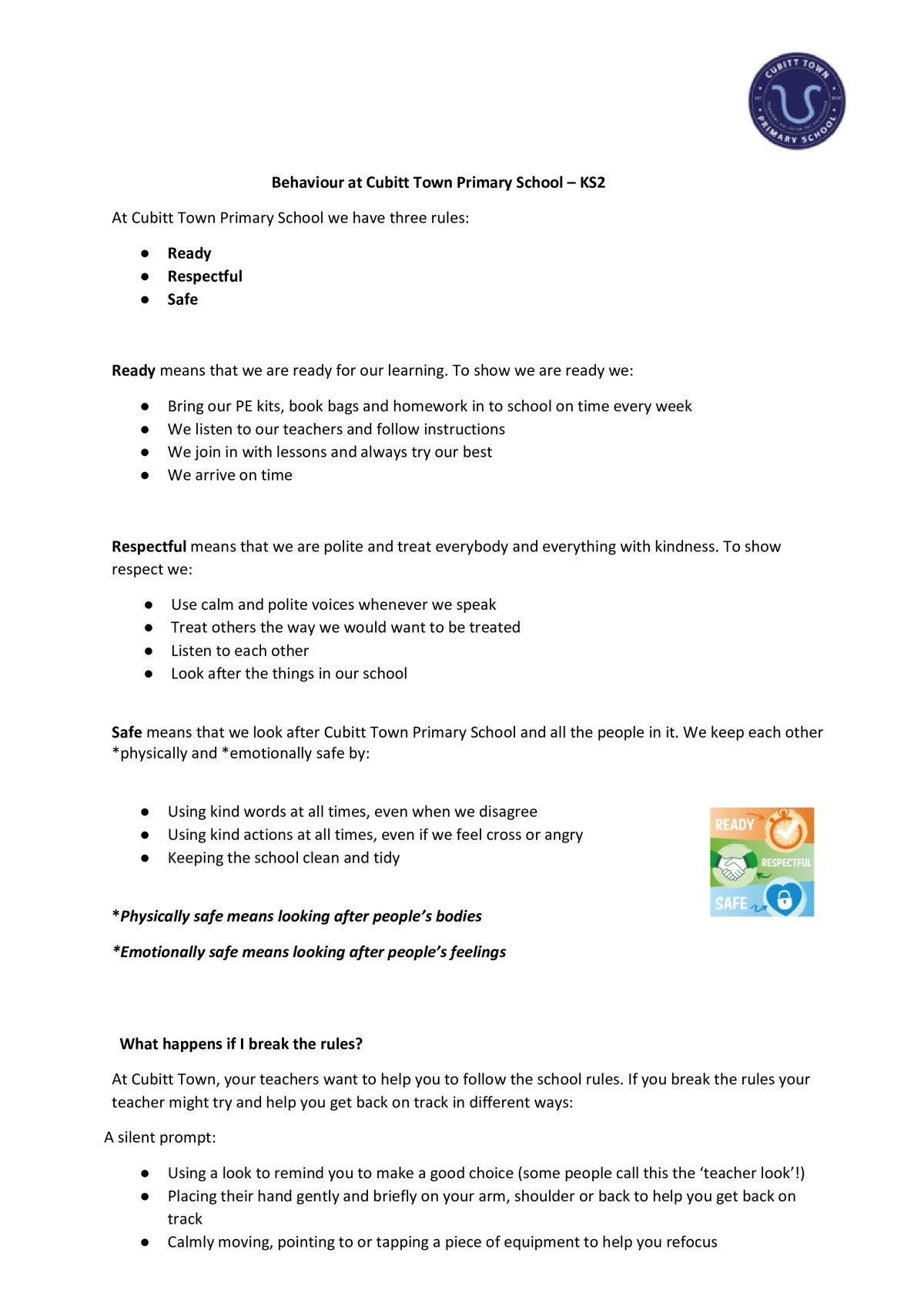
Being ready to learn
Respecting who and what is around us
Keeping ourselves and others safe
These link to our Cubitt Town 6C values as follows:

We promote and celebrate positive behaviour in a number of ways:
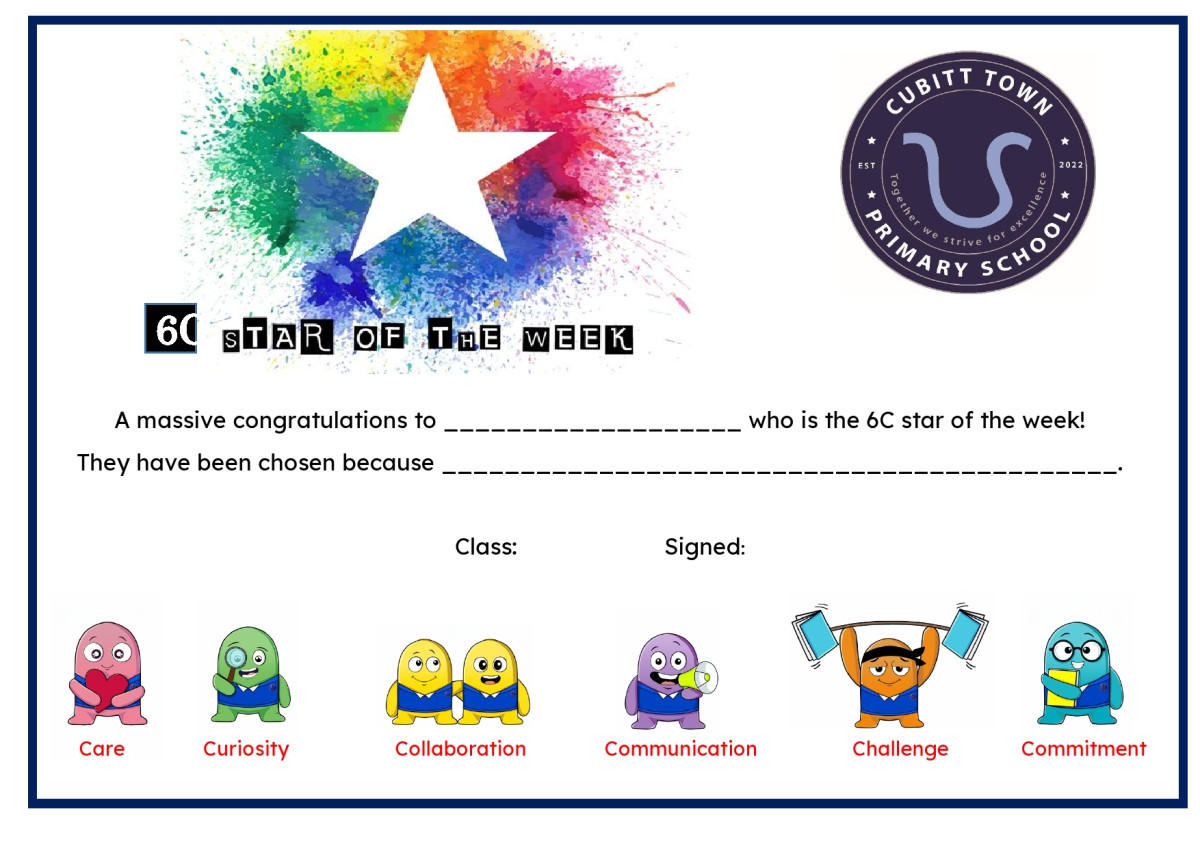
Each week teachers select a child who has made an outstanding contribution to one of our school values - communication, collaboration, challenge, caring, curiosity and commitment - as the class Star of the Week. Click here to find out more. Our Stars of the Week are announced in the weekly assembly and receive special certificates.
Children are rewarded Dojo points for excellent learning behaviours in class that align with our values, such as working collaboratively, helping others and challenging themselves. At the end of each half-term, the top three children in each class receive a certificate in school assembly. Parents are also informed when their children receive Dojo points.
Oracy is a key feature of our learning, and is practised in every lesson and every playtime and lunchtime. Our Oracy Stars of the Month are on display in the school and are celebrated in assembly.
Whilst we are proud of the pupil behaviour at Cubitt Town, we are also aware that sometimes issues arise and things can go wrong when children are together for such prolonged periods of time during the term. Our aim is to provide a consistent framework for behaviour management, in which expectations are clear for everyone in the community.
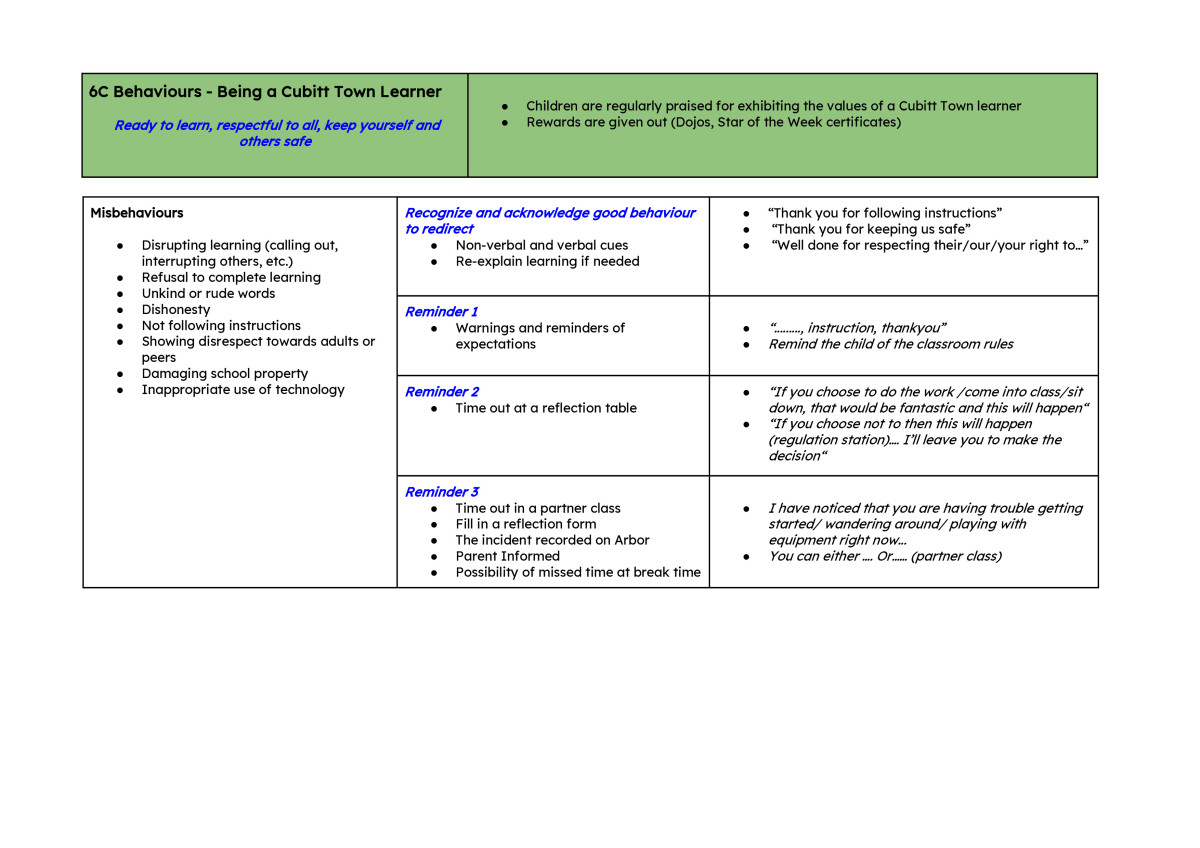
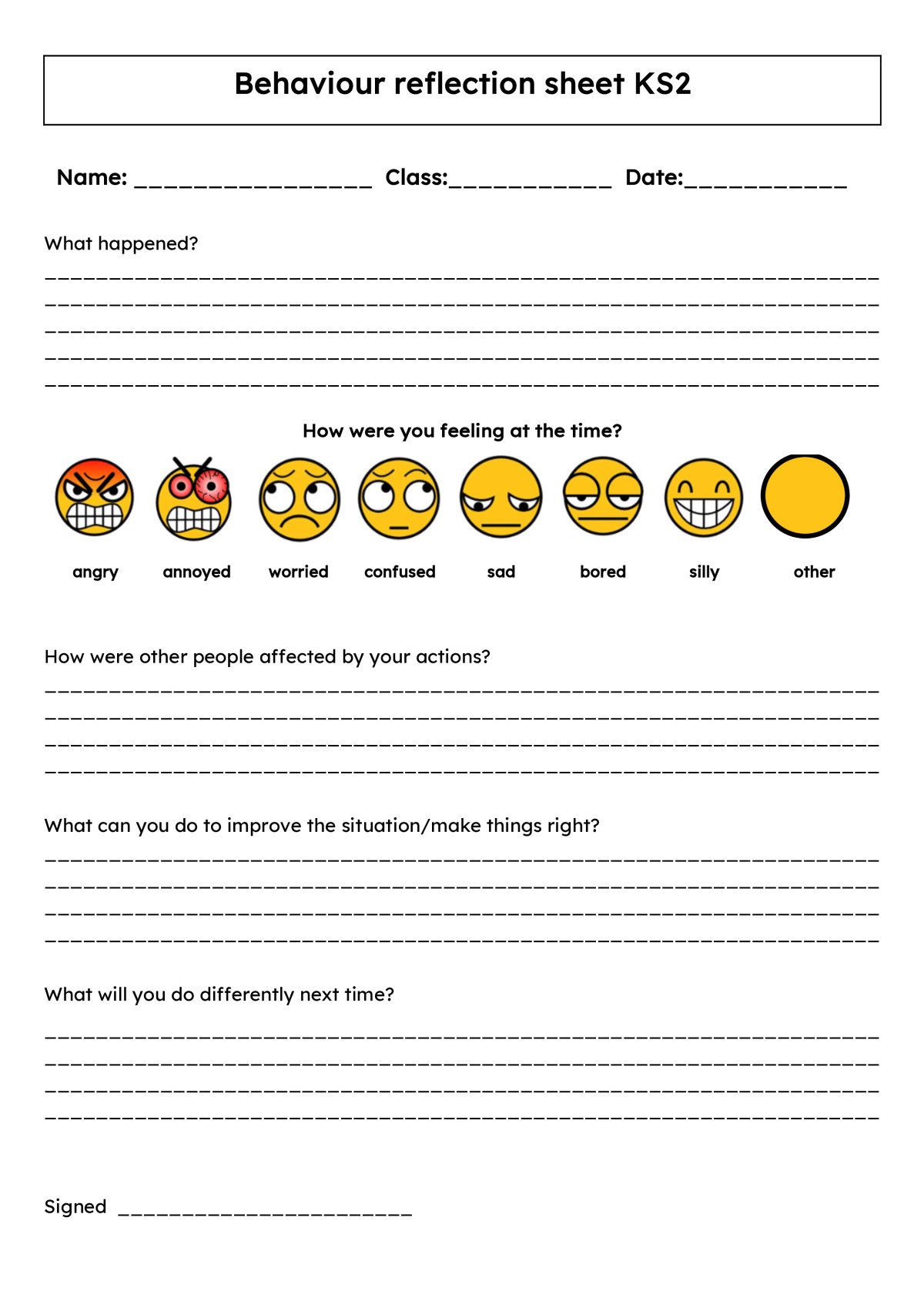
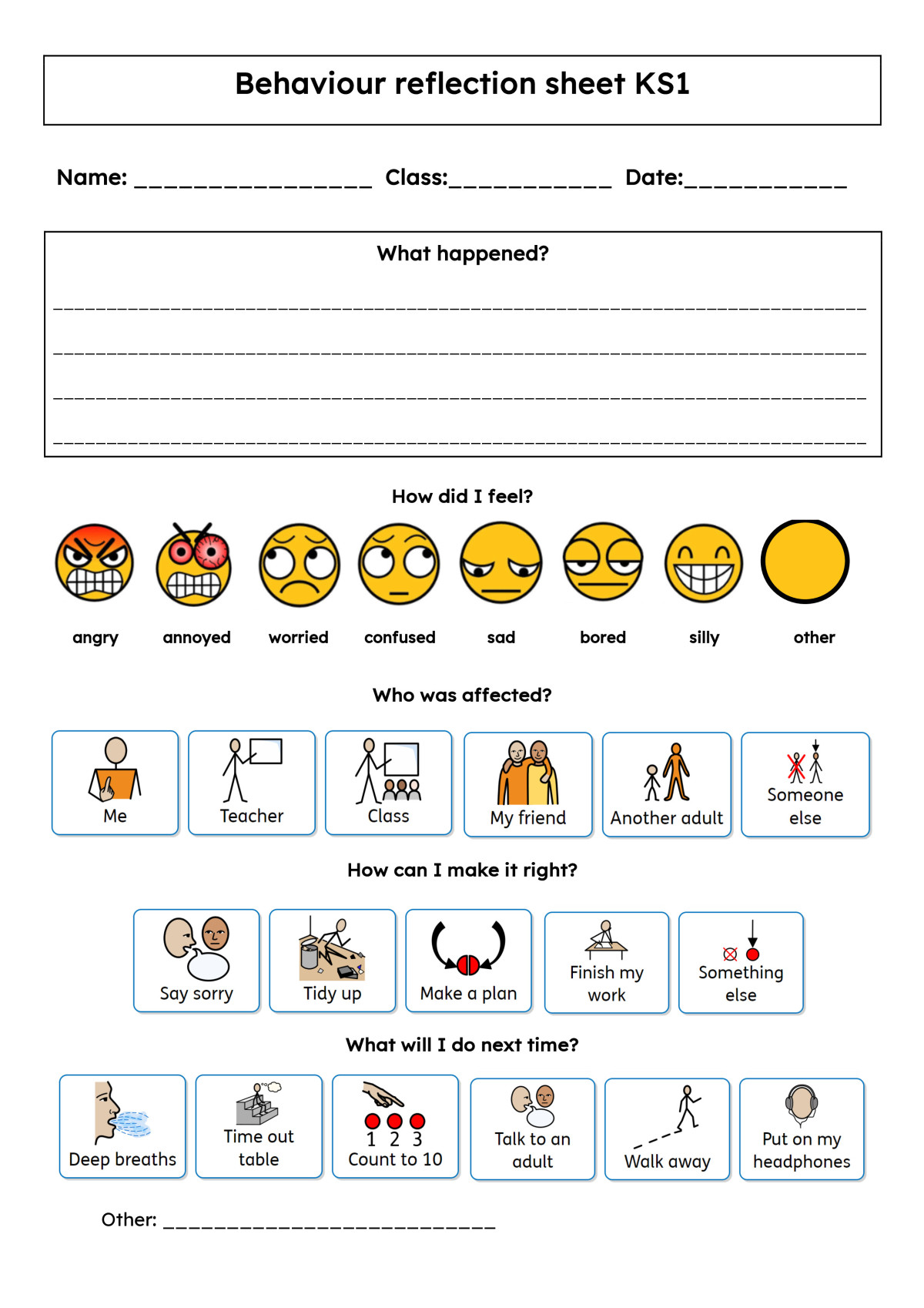
We have a clear protocol for when misbehaviour occurs, with clear steps and outcomes that all members of staff follow:

We have a structured approach to conflict resolution on the playground and encourage children to use their oracy skills to talk through issues that arise during play, using our Cubitt Town Peace Path (see appendix 8). This provides a structure and sentence stems to assist children in talking through issues. The playground team is trained in how to use the Peace Path to resolve conflict.
Misbehaviour on the playground is dealt with in a consistent manner and any incidents are dealt with calmly and fairly with all children’s accounts listened to. Play-fighting is not allowed on our playground, and children who play-fight will be asked to spend time out to reflect. More serious incidents including violence, discrimination and bullying are reported to the on duty senior leader. The length of time off the playground will be determined by the nature of the offence caused and any previous behaviour concerns that may have arisen. On these occasions our intention is to work in partnership with children and their parents, engaging in a joint problem-solving approach designed to lead to improvements in the behaviour of the child concerned and ensure the safety of others.

All children are taught how to identify and manage a range of emotions through the Zones of Regulation programme. The Zones of Regulation teaches regulation by categorising all the different ways we feel and states of alertness into four concrete coloured zones. They provide a system of self-regulation recommended by the Educational Psychology Service to help pupils self-regulate in both the classroom and playground. Self-regulation can go by many names, such as self-control, self-management, and impulse control. It is defined as the best state of alertness of both the body and emotions for the specific situation.
It is important to note to children that everyone experiences all of the zones - the Red and Yellow Zones are not ‘bad’ or ‘naughty’ zones. All the zones are expected at one time or another. The Zones of Regulation is intended to be neutral and non-judgmental.
The Red Zone is used to describe extremely heightened states of alertness and intense emotions. A person may be elated or experiencing anger, rage, devastation, or terror when in the Red Zone.
The Yellow Zone is also used to describe a heightened state of alertness and elevated emotions, however one has more control when they are in the Yellow Zone. A person may be experiencing stress, frustration, anxiety, excitement, silliness, the wiggles, or nervousness when in the Yellow Zone.
The Green Zone is used to describe a calm state of alertness. A person may be described as happy, focused, content, or ready to learn when in the Green Zone. This is the zone where optimal learning occurs.
The Blue Zone is used to describe low states of alertness and ‘down’ feelings such as when one feels sad, tired, sick, or bored.
At Cubitt Town Primary School, all children are taught about the different zones through PSHE lessons, oracy sessions, during speech and language sessions and in assemblies. Visuals to support children to identify their emotional state are displayed in each classroom. The zones are revisited every September and children are adults regularly model to children how to use the zones to describe and regulate their behaviour and emotions.

We believe that all of our behaviour expectations work best when we have a joined up approach between school and home. If you wish to discuss anything regarding behaviour, please do so with your child's class teacher at the end of the school day.